Internationaler Balltanz Club
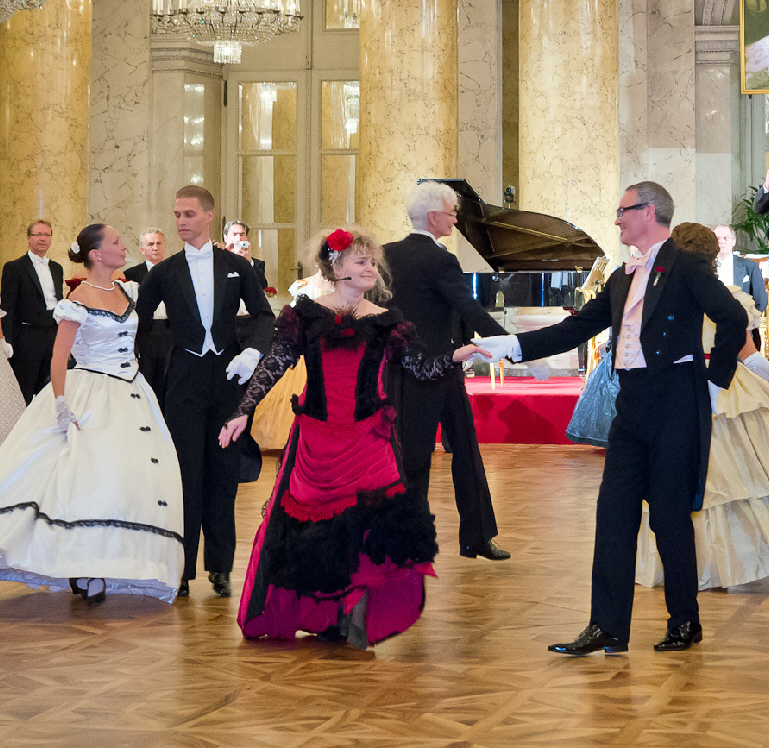
Gesellschaftstanz geboren im 19. Jahrhundert - Ballroom dances of the 19th century
Schwerpunkt in diesem Jahr: Paartanz in der Quadrille, choreografierte & geführte freie Paartänze - This year’s focus will be on couple dances in quadrilles, choreographed dances, lead and follow in free dances
⇒ Eventübersicht: Internationaler Balltanz Club 2018 (Deutsch)
⇒ Event overview: Internationaler Balltanz Club 2018 (English)
Tänze, die unterrichtet werden:
Quadrille „Sleigh Bell Polka“ Schlittenglocken Polka Quadrille (Philadelphia, 1866) | Quadrille „Strauss Quadrille“ Quadrille mit Polka, Varsovienne, Rheinländer, Mazurka, Galop, Walzer | Valse Russe „La Czarine“ (Paris 1857/ New York 1860) | Galop „Cachucha Galopp“ (Wien 1837) | Walzer „Mein Lebenslauf ist Lieb‘ und Lust“ (Wien 1869) | Schritt- und Führungstechnik in den Paartänzen | Quadrille à la cour (Berlin, seit 1855) - die Quadrille mit deutscher Tradition
Dances to be taught:
Quadrille „Sleigh Bell Polka“ (Philadelphia, 1866) | Quadrille „Strauss Quadrille“ Quadrille with polka, varsovienne, schottisch, mazurka, galop, waltz | Valse Russe „La Czarine“ (Paris 1857/ New York 1860) | Galop „Cachucha Galopp“ (Vienna 1837) | Waltz “My Life is Love and Joy” (Vienna 1869) | Step and Lead Technique in couple dances | Quadrille à la cour (Berlin from 1855)
Videos auf www.creanc.com
- Workshop
- Course
- 19th century
- Quadrilles
- Waltz
- Intermediates
- Advanced
- Professionals
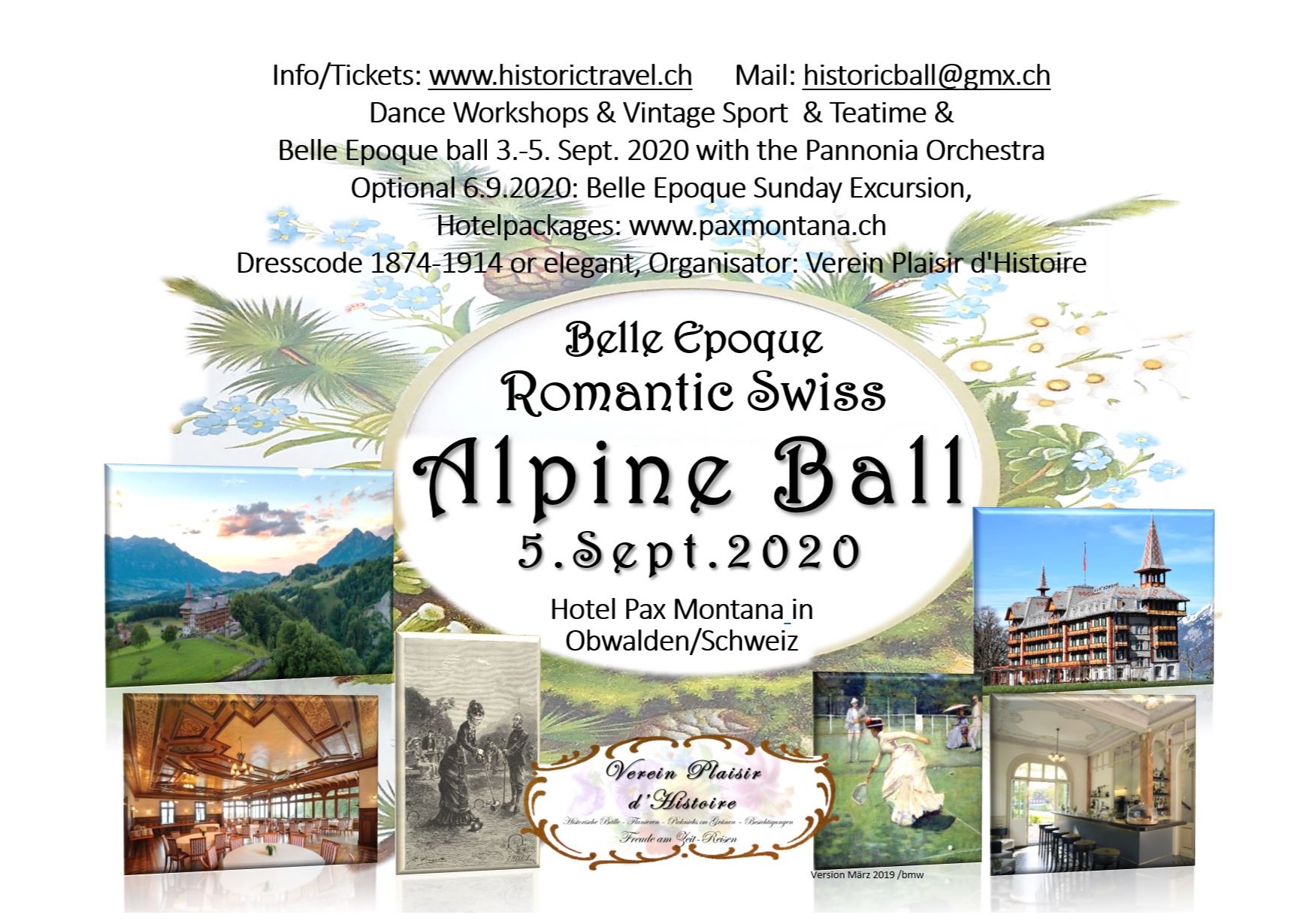
Romantic Swiss Alpine Ball
- Ball
- 19th century
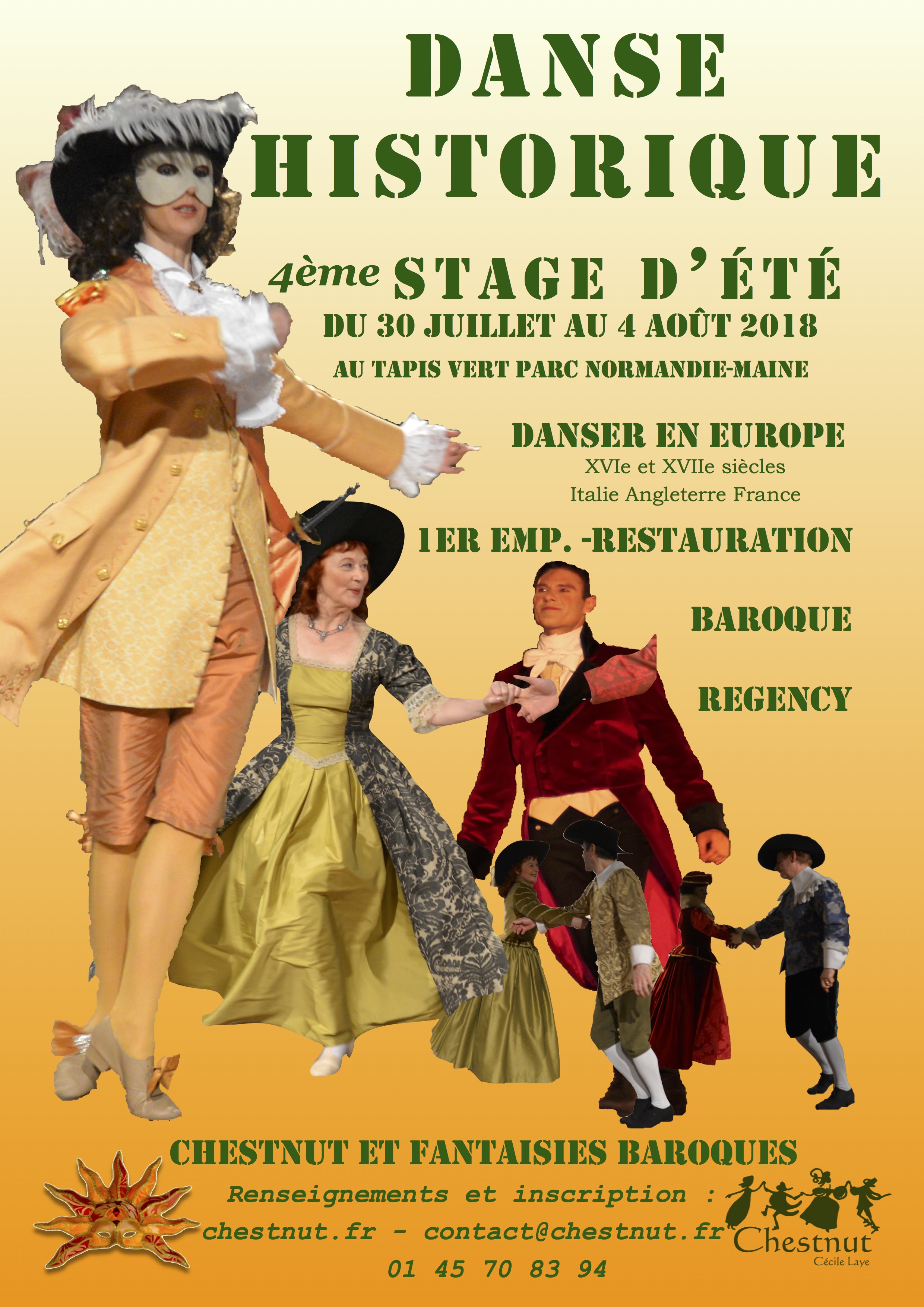
Historical Dances Summer Training Courses 2018
by Chestnut & Fantaisies Baroques

Chestnut and Fantaisies Baroques welcome you from July 30 to August 4, 2018 to their fourth summer school of period dances in Normandy.
- Dancing in Europe during the end of the 16th and the beginning of the 17th centuries (Italian, French and English tradition)
- Baroque dances
- Jane Austen & Regency dances
- French 1rst Empire - Restauration dances
With four different subjects and two instructors (Cécile Laye and Irène Feste), you’ll be able to make up your own schedule according to your tastes and how energetic you feel. You may opt for an intensive dance programme, up to 6 hours daily, or choose a mix of workshops and time for resting or for touring the area.
In our workshops, the programme allows for all levels of dancing. Each dancer will be taught variations suitable to his/her possibilities.Each day will start at 9 a.m. with a half hour of warming up exercises, led by each instructor in turn.
WORKSHOP DESCRIPTION
MORNING :
- Dancing in Europe during the end of the 16th and the beginning of the 17th centuries through the Italian, French and English traditions workshop (3h : 9h45-12h45): Cécile Laye, The workshop will cover several modern dances. The focus will be on squares for two couples and dances including one or several heys. France: Les Bouffons, out of Thoinot Arbeau’s Ochésographie (1588), first and third passages. Italy: Bizarria d'Amore, choreographed by Cesare Negri and published in his 1602 book, Le Gratie d'Amore. England: Hit and Miss and Parson's Farewell, dances known at the time of Elisabeth 1st and James 1st, collected by the London publisher John Playford in the 1651 edition of The English Dancing Master.
or
- Baroque dances workshop (3 hours: 9:45-12:45): Irène Feste, La Lorraine de Balon, ball dance for one man and one woman, composed on a rigaudon de Provence music. This dance appears in the XVIIth Recueil de danses pour l’année 1719.
AFTERNOON :
- Jane Austen's and Regency dances workshop (1h30 : 15h/16h30 or 17h/18h30 on alternate days): Cécile Laye, Some figures were kept through English 17th and 18th century dances, from circles for eight to cotillon, with Newcastle (John Playford,1651) and La Nouvelle Promenade (James Fishar,1775). We’ll see the use of perpendicular lines in both these dances – they also occur in many choreographies of the period. The workshop will include a proposal for stepping in a longways duple minor set. At the start of the 19th century it became fashionable to use traditional Scottish and Irish steps in longways for as many as will while the figures in longways became much simpler than in earlier times. The stepping proposed will be based on Countess of Yarmouth's Fancy (Alexander Wells, 1800)
and
- French 1rst Empire - Restauration workshop (1h30 : 15h-16h30 or 17h-18h30 on alternate day): Irène Feste, The Mazurka arranged by Saint Léon for H.R.A. Prince Charles of Württemberg and the Allemande created for the three princesses. These dances made up by Michel Saint Léon, whose son was Arthur Saint Léon, the famous dancer, were meant for the princes and princesses of the Württemberg house to improve their education and enable them to dance at the court balls. During the first third of the 19th century Mazurka was quite fashionable in all great European salons. L’Allemande à trois consists in a series of interweaving movements and figures for which we could make up names, such as arches, rosette, revolving around the sun…
EVENING ACTIVITIES
Evening entertaiment will be organized for trainees and instructors to share a good time:
- Tuesday: team quizz on period dances
- Wednesday: films
- Thursday: will be decided by trainees
- Friday : Costume Ball including the dances studied in the workshops. (Please note: costume is not a must.)
TEACHERS

Cécile Laye studied historical dances in England with Dolmetsch Historical Dance Society, Nonsuch History and Dance and EFDSS (English folk Dance and Song Society). She studied in particular with famous teachers or researchers such as Anne Daye, Anne Cottis, Peggy Dixon, Ethyl Anderson, Marjorie Fennessy, Tom Cook and Alan Davies. In France, she studied under Francine Lancelot, Andréa Francalancci and Barbara Sparti. In 1998 she founded the CHESTNUT company to make available the repertoire of figure dances of the time of the Stuarts and the English inheritance, from a literary and historical point of view, in collaboration with musicians, dancers, actors, singers, horse riders and fencers. She also graduated from Cours Florent in acting and staging.

After a diploma in ballet dancing, Irène Feste studied « Belle Dance » with L’Eclat des Muses, a company led by Christine Bayle. In 2007, she founded her own company with Pierre-François Dollé: Fantaisies Baroques. They design and perform dance/theatre shows in schools and music schools. Irène Feste specialises in baroque and Premier Empire (Napoleonic time) dances, her two main fields of research. She regularly dances with compagnie Divertimenty.
VENUE
Le Tapis Vert, a residence for artists nestling in a large estate in the Normandie-Maine park, offers several accommodation possibilities on site, from boarding-house to rented rooms and camping. Also on site, two superb halls for activities and a circus tent make for a high quality environment.


FEES
Tuition prices (€/pers.) :
1 hour 30 Module : €125
- French 1rst Empire - Restauration (1h30 in the afternoon)
- Jane Austen & Regency dances (1h30 in the afternoon)
3 hours Module : €216
- Baroque dances (3 hours in the morning)
- Dancing in Europe 16th & 17th centuries (3 hours in the morning)
- French 1rst Empire - Restauration + Jane Austen & Regency dances (2 x 1h30 in the afternoon)
4 hours 30 Module : €288
- Baroque dances (3 hours in the morning) + French 1rst Empire - Restauration or Jane Austen & Regency dances (2 x 1h30 in the afternoon)
- Dancing in Europe 16th & 17th centuries (3 hours in the morning) + French 1rst Empire - Restauration or Jane Austen & Regency dances (2 x 1h30 in the afternoon)
6 hours Module: €336
- Baroque dances (3 hours in the morning) + French 1rst Empire - Restauration and Jane Austen & Regency dances (2 x 1h30 in the afternoon)
- Dancing in Europe 16th & 17th centuries (3 hours in the morning) +French 1rst Empire - Restauration and Jane Austen & Regency dances (2 x 1h30 in the afternoon)
Accommodation and meals prices (€/pers.) : see them on chestnut.fr
Please, note : before you fill in your registration form,please check with us calling 0033 6 60 22 23 21 to find out which type of accommodation is still available.HOW TO GET THERE
Reaching Tapis Vert
- By car
Le Tapis vert is 200 km away from Paris and 130 km away from Rennes.
- By train
The nearest train station is Alençon, reached either through Surdon from Paris Montparnasse-Vaugirard or by TGV through Le Mans. Share taxi or car from Alençon station.
A shuttle will be organized to fetch the trainees arrived at the station of Alençon by the train of 4:07 pm. Thank you for indicating us that you will arrive by the train.TRAINEES’ WELCOME
Trainees are welcome from 17:00 on Monday July 30, 2018.
Please note : as no evening meal is provided on the first day evening (Monday), please bring a picnic dinner !
Departure on Saturday, August 4 after breakfast.
REGISTRATION
Please note : before you fill in your registration form, please check with us calling 0033 6 60 22 23 21 or contacting us at contact@chestnut.fr to find out which type of accommodation is still available.
Registration form here
Payment from abroad : please contact us
CONTACT- INFORMATION
contact@chestnut.fr ou 0033 6 60 22 23 21
- Workshop
- Summer School
- Course
- Renaissance
- Cinquecento
- French Renaissance
- Baroque
- Playford
- 19th century
- Quadrilles
- Regency
- All levels
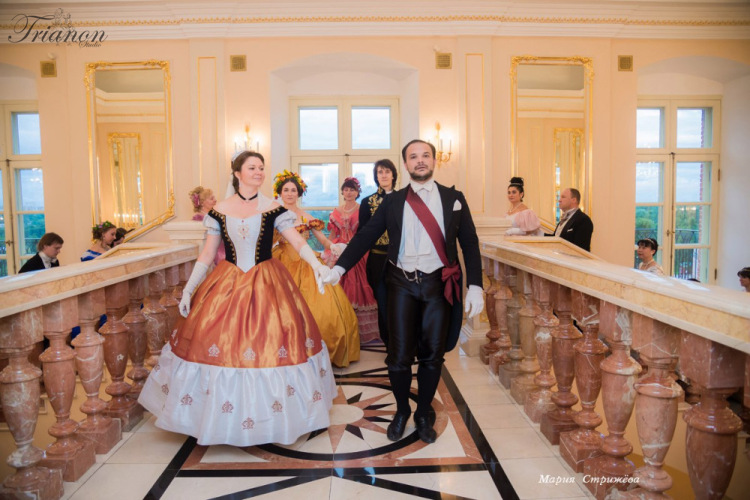
X International Historical Dance Festival
They say, if you want to see European Russia you should go to St. Petersburg
but if you want to feel a truly Russian spirit you can feel it only in Moscow.
We would like to celebrate our X anniversary with a whole lot of illustrious events exchanging experience and dancing together with our colleagues from other countries. It is a great opportunity to get to know different dance styles and ballroom atmosphere of other schools and meet new friends.So our dear guests will have:
- Dance classes by the very famous and everyone's favourite maitre Arnaud Degioanni from France, the head of "Carnet de Bals" Association.
- Historical Dances in English traditions by Zsuzsi Dingsdale from Hungary.
- Experience Interchange with some European Dancing Groups.
And the balls!
- Open Ragtime Ball in one of Moscow parks,
- Russian Ball at the Izmaylovo Kremlin,
- Scottish Ball
- and the traditional Grand Ball in one of Moscow manors.
We are waiting for you at our Festival!
- Workshop
- Summer School
- Ball
- Ongoing classes
- Course
- 19th century
- Quadrilles
- Regency
- Waltz
- Costumes
- mixed
- Intermediates
- Advanced
- All levels
Tanzgruppe Rossina
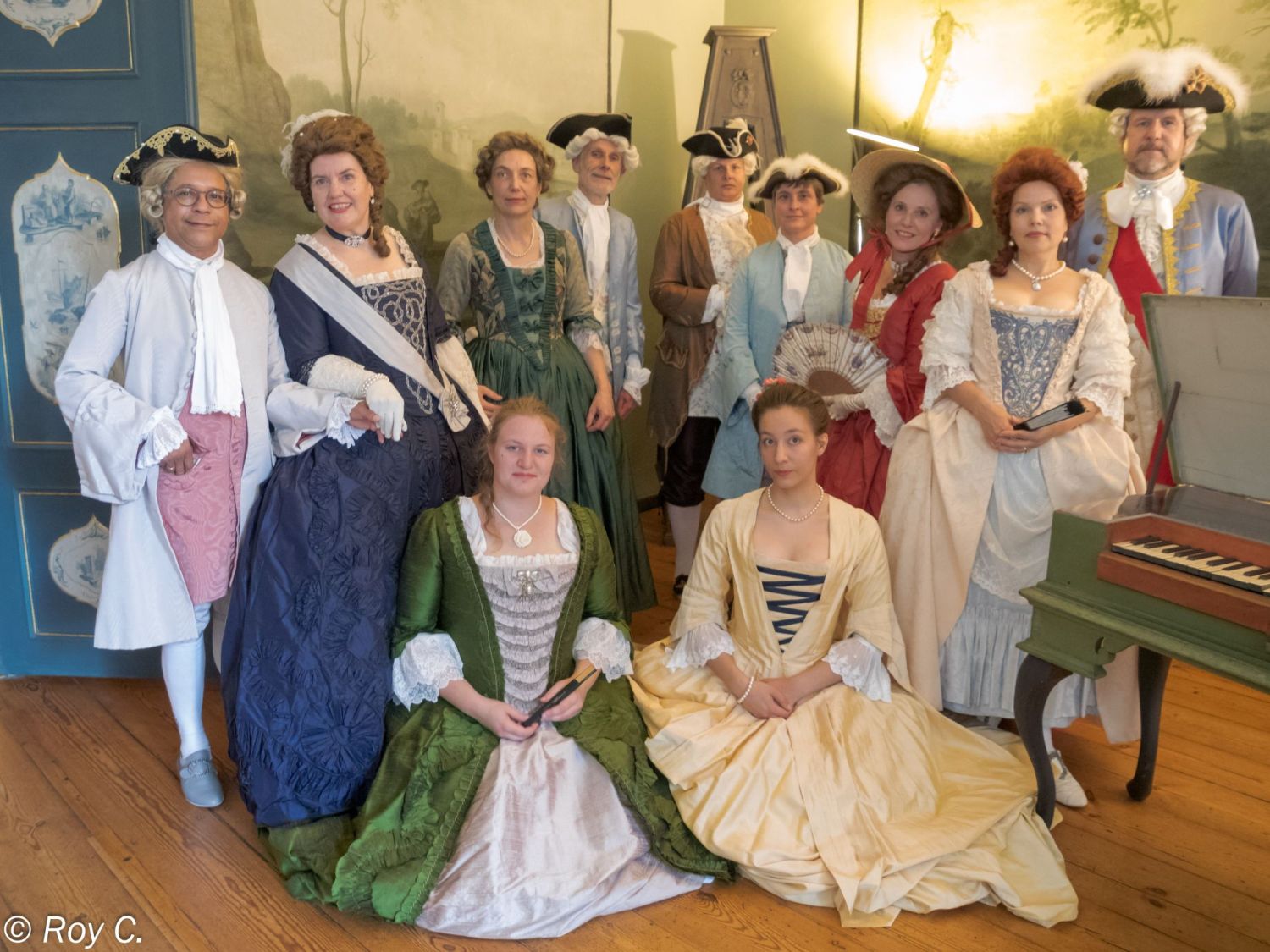
Tanzensemble ROSSINA in Hamburg, geleitet von Birte Hoffmann-Cabenda,wurde 1982 gegründet Die Gruppe ist altersmäßig gemischt. Neue Mitglieder sind uns stets willkommen.
- Dance group
- Renaissance
- Baroque
- 19th century
Galabal hofdansvereniging Plaisir Courtois
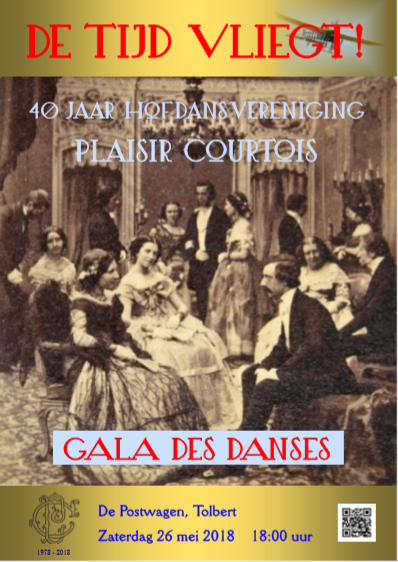
Plaisir Courtois celebrates her 40th anniversary with a gala-ball. There is a possibility to practice in the afternoon. Dinner is included.
We hope to see you there!
Tickets are available on www.plaisircourtois.nl/lustrum
- Ball
- Renaissance
- Playford
- 19th century
- mixed
- All levels
De Tijd Vliegt
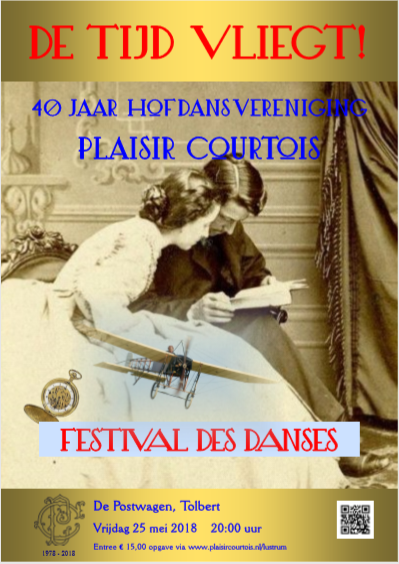
Plaisir Courtois celebrates her 40th anniversary with a special performance. We will travel through time starting in the 16th century and ending in the early 20th century. We work together with several other historical dance-groups from the Netherlands. We hope to see you there!
Tickets are available on www.plaisircourtois.nl/lustrum
- Performance
- Renaissance
- Baroque
- 19th century
- mixed
7° STAGE DE DANSE DU XIX SIECLE A PARIS
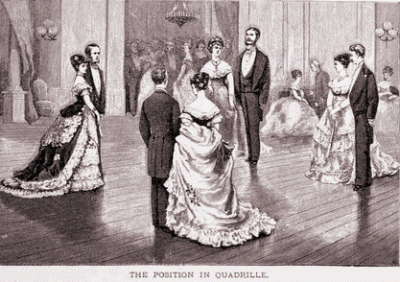
Je vous attends Samedi 14 Avril a Paris a l'ecole Paris Mambo, 48 Rue de la Gare de Reuilly , pour le Stage de danse du XlX siecle de 16.00h a 19.00 h au programme il y aura de très belles dances du repertoire du XIX siècle !!!Carla Favata
- Workshop
- Course
- 19th century
- All levels
Grand Ball 'della Seta' 2018
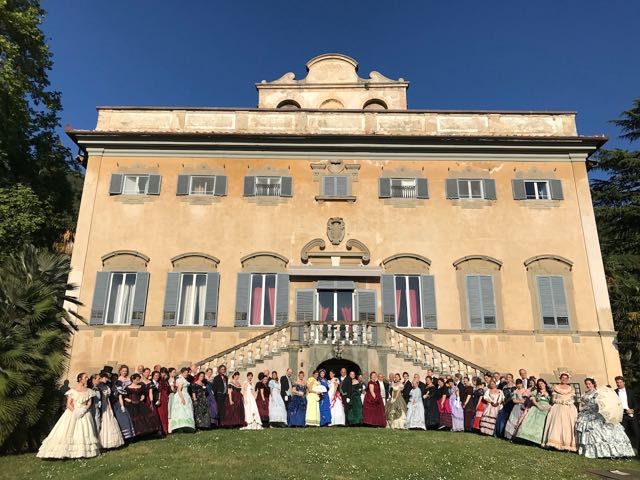
Gran Ballo della Seta
19th Century Grand Ball
3.6.2018, Villa della Seta di Corliano
San Giuliano Terme (Pisa)
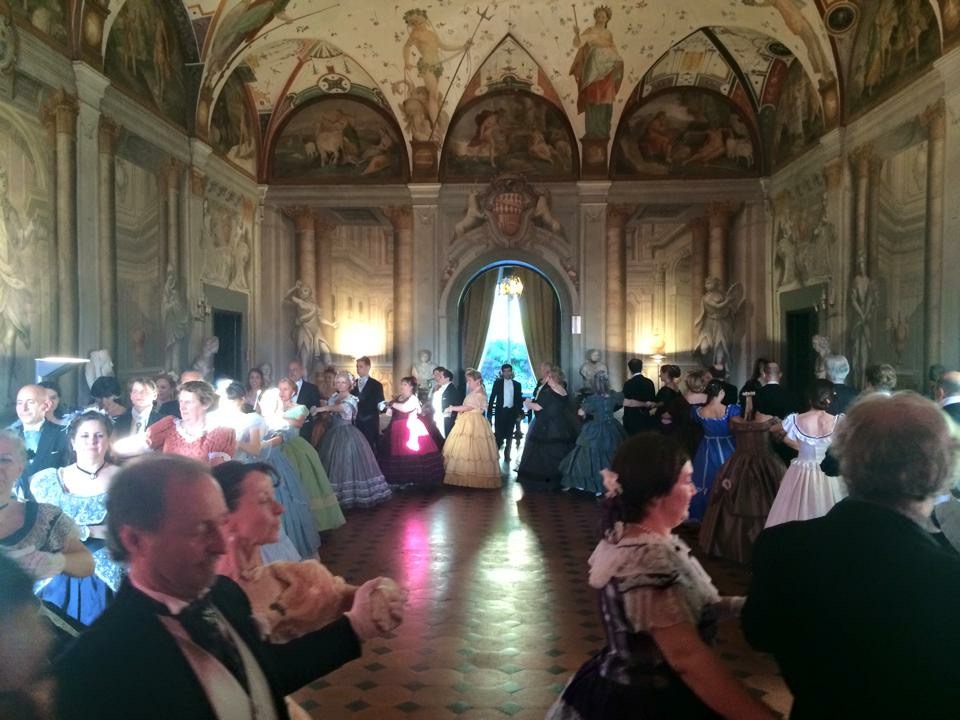
Circolo Pisano della Società di Danza organizes anreconstruction of a 19th Cenntury grand Ball in the marvellious historical Villa Agostini della Seta di Corliano, close to Pisa.
Quadrilles, waltz, polka and mazurkas, contredanse and marches, Scottish country dance and aglio.
The ball will take place in the elegant and charming main salon with ancient frescoes of Villa della Seta di Corliano.
A tea buffet will be served in the beautiful park with secular plants.
Villa di Corliano is recognized as one of the most beautiful renaissance Villas in Tuscany. Participation by invitation.
Dress code: 19th Ball dress romantic period.
To participate contact
Circolo Pisano della Società di Danza
- Ball
- 19th century
- All levels
Gran Ballo delle Cinque Giornate 2018
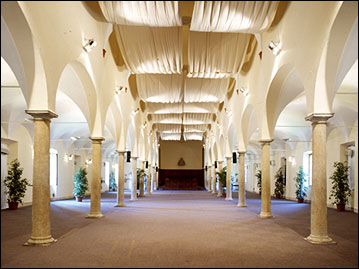
Gran Ballo Risorgimentale - 19th Century Grand Ball
Sala delle Colonne, Museo Nazionale della Scienza e Tecnologia
Società di Danza - Circolo Milanese
25.3.2018
directed by F. Mòllica
To celebrate the 'Cinque Giornate di Milano' (the Five Days in Milano), one of the major episodes in the history of Italian Risorgimento of the nineteenth century in 1848.
in collaboration with the 'Museo Nazionale della Scienza e Tecnologia', in the 'Sala delle Colonne'.
Waltz, quadrille, contredances, mazurka, polka, marsch.
For further information contact
Societa' di Danza - Circolo Milanese
- Ball
- 19th century
- All levels